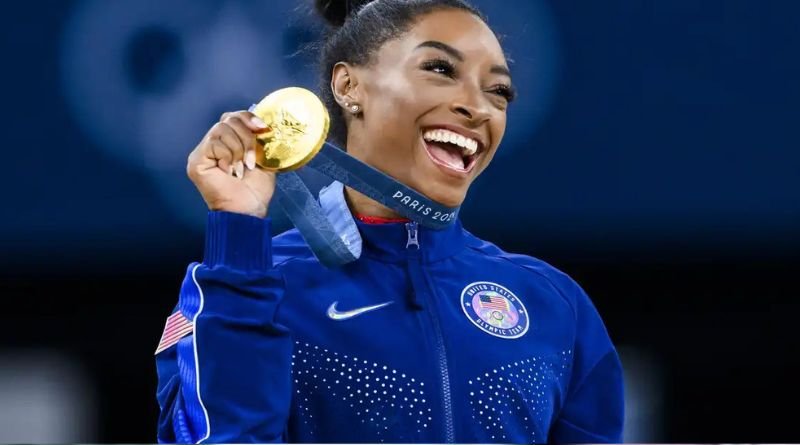
From the Gym Floor to the World Stage — The Career That Rewrote the Record Books
There is a version of the Simone Biles story that can be told entirely through numbers, and those numbers are staggering enough on their own. She is an American artistic gymnast with a net worth of $25 million, more than 30 medals across Olympic and World Championship competitions, seven Olympic gold medals, two silver medals, and two bronze medals — a collection that makes her not just the most accomplished American gymnast of all time but, in the eyes of most people who follow the sport seriously, the greatest gymnast the world has ever produced. That assessment is not hyperbole or fan enthusiasm. It is a position held by coaches, analysts, former competitors, and athletes across disciplines who recognize what she has achieved relative to what the sport demands. But the numbers, as impressive as they are, do not fully capture what it has felt like to watch Simone Biles compete at her best — the combination of power, precision, and apparent ease that makes the most difficult skills in gymnastics look almost routine when she performs them.
The competitive record that underpins her net worth was built through relentless consistency across a career that started earlier than most people realize and has sustained its peak longer than anyone had a right to expect. She won her first US championship in 2013 at just age 16, a moment that announced her as something genuinely different from the athletes who had come before her. What followed was not a brief period of dominance followed by a gradual decline — it was a sustained reign at the top of the sport that stretched across more than a decade and multiple Olympic cycles. She won the US championship eight times in total, claiming her eighth US championship in August 2023 at age 26, a point in a gymnast’s career when most athletes have long since retired. That longevity is one of the most underappreciated aspects of her legacy and one of the key reasons her net worth has been able to grow the way it has — a longer career at the top means more Olympic cycles, more World Championship medals, more visibility, and more leverage in endorsement deals with the largest companies on the planet.
The 2016 Summer Olympics and the Moment That Made Her a Global Name
If there was a single moment when Simone Biles crossed from being the best gymnast in the world to being a genuine global phenomenon, it was the 2016 Summer Olympics. She arrived in Rio as the heavy favorite and delivered the kind of performance that exceeded even the most optimistic expectations. Competing as part of the US team known as the Final Five, she collected individual golds in floor, vault, and all-around — three of the most prestigious individual events in artistic gymnastics — along with a bronze on the balance beam and another gold as a member of the US team. That haul from a single Olympic Games would represent a career highlight for almost any athlete. For Simone Biles, it was the confirmation of something that people inside gymnastics had already known for years but that the wider world was only just beginning to fully understand. The 2016 Summer Olympics turned her into the kind of athlete whose name carries meaning to people who have never watched a gymnastics competition in their lives, and that level of name recognition is directly tied to the endorsement deals and contracts that have contributed significantly to her $25 million net worth.
The financial rewards that followed the 2016 Summer Olympics were substantial and reflected her new status as one of the highest-paid Olympic athletes in the world. She became the most-marketed US athlete in terms of endorsements in the years that followed, signing contracts with some of the largest companies across multiple industries — a portfolio of endorsement deals that generated an estimated $20 million in the years leading up to and following the 2020 Summer Olympics. That $20 million from endorsements alone is a remarkable figure for a gymnast, a sport that has historically been financially undervalued relative to the physical demands and dedication it requires from its athletes. Simone Biles changed that conversation, both through her performance and through the deliberate and principled way she approached her commercial relationships — treating them as genuine partnerships rather than simple transactions.
Tokyo, the Twisties, and the Comeback That Added a New Chapter
The 2020 Summer Olympics in Tokyo — which took place in 2021 after a COVID delay that added more than a year of waiting and uncertainty to an already complicated preparation — became the most publicly discussed chapter of Simone Biles‘s career for reasons that had nothing to do with gold medals. After experiencing a case of what gymnasts call the twisties — a condition where an athlete temporarily loses their air balance awareness mid-performance, creating serious safety risks on apparatus where spatial orientation is literally the difference between landing and injury — she made the decision to partially withdraw from the competition. She returned to claim a bronze on the balance beam and a silver with the team, but the circumstances of her withdrawal generated a global conversation about mental health, athletic pressure, and the responsibility that elite competitors have to themselves as human beings rather than just as performers.
From a financial and professional perspective, the way Simone Biles handled Tokyo arguably increased her long-term value rather than diminishing it. The decision to prioritize her own wellbeing over medals resonated with audiences and brands that had become increasingly focused on the values behind the athletes they partnered with, and her standing as the most-marketed US athlete in terms of endorsements was not seriously damaged by the withdrawal. If anything, the authenticity and courage she demonstrated during that period deepened the connection between her personal brand and the audiences that follow her — an outcome that matters to the largest companies writing endorsement deals and contracts with athletes at her level. She had already signed with Athleta just three months before the Tokyo games in a move that reflected her growing emphasis on value alignment in her commercial relationships, and that partnership positioned her well for the period of reflection and recovery that followed.
Eight Championships, Thirty Medals, and a Net Worth That Reflects a Once-in-a-Generation Career
Looking at the full picture of Simone Biles‘s career — from the first US championship in 2013 to the eighth US championship in August 2023, from the 2016 Summer Olympics to Tokyo and beyond, from individual golds on floor, vault, and all-around to the bronze on balance beam and the silver with the team — what you see is a career that has been built on an almost incomprehensible combination of physical ability, mental strength, longevity, and the kind of cultural significance that turns athletic achievement into something larger than sport. Her net worth of $25 million reflects all of that — the prize money, the endorsement deals with the largest companies, the contracts that have run for years and extended well into the future, and the $20 million in endorsements that made her the most-marketed US athlete of her era. She is one of the highest-paid Olympic athletes in the world not just because she has won more Olympic and World Championship medals than anyone else in her sport, but because the story of how she won them — and how she handled the moments when winning was not the most important thing — has made her one of the most genuinely compelling figures in the history of athletics. The greatest gymnast in the world has also built one of the most well-rounded and financially substantial careers in the history of American Olympic sport, and the $25 million net worth that results from it is both a fair reflection of her commercial value and a significant underestimate of her cultural one.